The Givers Fund
Due Date: 11:59pm Pacific Time on October 15th, 2026
Questions: givers.grants@sfwa.org
The purpose of the Science Fiction and Fantasy Writers Association is to promote, advance, and support science fiction, fantasy, and related genre writing in the United States and elsewhere, by educating and informing the general public and supporting and empowering science fiction and fantasy writers.
One of the most important ways we fulfill our purpose and mission is through our annual Givers Fund grant awards. Each year, the SFWA Givers Fund uses a pool of money set aside specifically for SFWA to support other organizations, activities, and programs that work to educate or empower writing, reading, and engagement in the speculative fiction writing field.
Givers Fund grants are outward-facing, and they raise awareness of the speculative fiction genres in some way. In short, your project must fit with SFWA’s mission! It’s up to you to define how this is accomplished within your application.
If you or your organization’s passion project fits that bill, proceed to completing a grant application! BUT… before you hit that APPLY button at the bottom of this page, be sure to read through the FAQ. Once you hit APPLY, you’ll notice that there are separate applications for nonprofit organizations as well as other potential recipient groups.
Here is a list of Frequently Asked Questions (FAQs) about the Givers Fund grants. These should help you decide how best to present your project and make sure that this grant is the right one to support your efforts. And remember: We want your application to be successful! So please ask if you need additional clarifications before submitting it. We’re ready for your questions at givers.grants@sfwa.org.
FAQs on the SFWA Givers Fund Grants
If you’re applying on behalf of a new activity or project, it behooves you to partner with an established 501(c)(3) organization that can sponsor the project and be the actual applicant.
1. Who is the ideal applicant for a Giver’s Fund grant?
Any 501(c)(3) or similar organization (e.g., municipal organizations, churches, schools, or any entity considered to be there for the public good in some way) with a program related to the speculative fiction genres. Perhaps you work with a library that wants to lead an SFF reading or writing program. Maybe you’d like to supply books to a local school or fund another year of your free seminar series for speculative fiction writers. Whatever the program or entity, it must have a strong SFF orientation.
2. Must applications be submitted by a SFWA member?
No. SFWA members often show up in grant applications and/or help another organization or entity to apply, but membership is not required as a condition for grant application. Anyone with a favorite group that promotes SFF can encourage or help that organization apply.
3. Do applicants need to be registered as nonprofits or can they be more loosely organized groups?
501(c)(3) and similar organizations have an easier vetting process, but anybody can apply. Givers Fund grants have gone to individuals in the past, though rarely (See: FAQ #5). Most often, grants go to groups that organize reading series, conventions, educational series, and similar events. If you’re in doubt, ask!
4. Can a for-profit organization apply?
Yes, they can, but they have a very high bar to get over. The grant cannot benefit the organization’s owner(s). In fact, it cannot benefit any individual: the funds must be used to pay for expenses, not to generate profits or income, whether for the applicant, a speaker, or any other individual or business.
5. Can an individual writer apply to support their own work?
They can apply, but unless “their own work” is offering a course, a workshop, or some other public-facing effort, the chances that it would be funded are slim.
Rephrased: This funding pathway won’t support you while you write.
In addition, the grant can’t support the writer in terms of income. It can support expenses, even ones previously paid from the writer’s pocket for the project, but a grant along those lines would have to meet a really high bar to be awarded.
6. What sorts of expenses can Givers Fund grants be used for?
The easiest way to think of it is “We pay for things, not people.”
We’re looking for reimbursable business expenses supported by receipts, including some of the expenses to run a not-for-profit workshop (though not paychecks for the facilitators), event travel and rental fees, advertising expenses, web hosting expenses, software expenses, in-person workshop scholarships, electronic readers, and copies of books for reading groups.
7. What expenses are off-limits?
Payments to writers for articles or fiction, honorariums, stipends, speaker fees, and similar are not eligible for this fund. Givers Fund grants are not intended to create taxable income for the recipient or for any individual involved with the project. By covering other costs, the grant may in practice enable you to free up money to pay individuals, but it cannot be the direct source of that income, and proposing such a workaround will not aid your application.
Also, we don’t pay for an organization’s legal fees to become a 501(c)(3), nor do we pay start-up expenses for a new effort, and we don’t support contests.
8. So an organization could apply for funds to rent event space or pay for Zoom hosting fees, but not to pay a speaker an honorarium?
Yes.
9. How much money is typically awarded to a grant winner?
Our available funding pool varies from year to year (see: Fundraising for more), but there are specific limits to how much we award. Organizations are limited to a maximum of $3000 for the grant year, while individuals are limited to $1500. In the past, grants have ranged from a few hundred dollars up to the limit. We may not give you everything you ask for, and partial awards are common. Please limit your request to what you need, not just ask for the maximum amount allowed! The grant committee awards as many grants as possible in a given year, making it rare that any one grant application will receive all the funds they apply for.
I0. Are there any tips or best practices that make an application more likely to win a grant?
Advocate for a good cause that benefits the field. Include a decent budget breakdown. Apply for an ongoing project or event that has a track record the committee can review in literature provided with the application or on public-access websites. If you’re applying on behalf of a new activity or project, it behooves you to partner with an established 501(c)(3) organization that can sponsor the project and be the actual applicant, as they are more likely to have that track record established.
If the project serves a broad public audience, usually for free, it’s a likely candidate. Workshops for current or new SFF writers, reading series, public library programs, convention activities: these are most heavily favored applications, especially when run by a charity or similar organization. But there are always exceptions! We have funded projects as varied as archival work to protect and promote the speculative fiction genres, to a science fiction musical theater production.
11. What are common errors or mistakes you see in applications for the Givers Fund grants?
- Claiming to be a 501(c)(3) when you’re not.
- Asking for money to pay people or oneself.
- Asking for a grant that doesn’t focus on speculative fiction.
- Making specific mention of a SFWA member or SFWA Board member who will be teaching or appearing at the event. (This is more likely to generate problems for your application, because it creates potential conflicts of interest.)
- Not having “your ducks in a row,” meaning that your entity is not in good standing with the IRS or its state registration.
- Failing to provide basic information about the entity’s structure and location.
Remember:
The primary goal of the project should be uplifting the speculative fiction genres. If your project is also intended to uplift marginalized populations, that’s great and it should be mentioned–but as a secondary goal. The Givers Fund was not established specifically for that purpose. It’s best to emphasize in your application how the project advances SFF overall, and then add commentary on how it also advances representation of marginalized populations in the speculative-fiction community.
12. What are some of the organizations that have been awarded Givers Fund grants?
Some of our recent recipients include:
- An “Astronomy for Writers” program at the University of Wyoming.
- The science fiction musical we mentioned earlier.
- Con or Bust.
- The Art and Words show in Dallas.
- The Speculative Literature Foundation.
- A summer camp for creating short films.
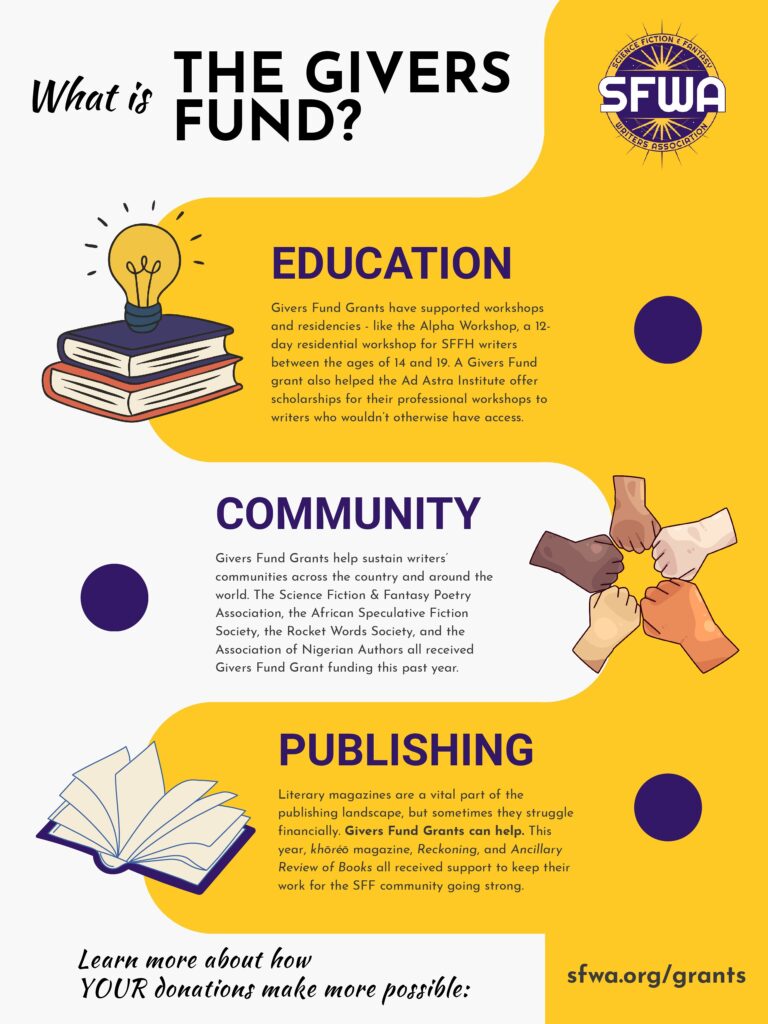
- Alpha, Clarion, Odyssey, and Turkey City workshops.
- Reading series in Denver and Iowa City.
- The African Speculative Fiction Society.
- The Dream Foundry.
The list is long and rich, and we look forward to seeing new names on it.
- What’s the process after someone sends in their application?
- We vet the application for eligibility and completeness.
- If the application is incomplete, we make a good faith effort to reach out to get the missing information.
- Completed applications passing Steps 1&2 are reviewed by the CFO for due diligence, to ensure the entity is in good standing with the IRS and state authorities and is what it claims to be. We then review the provided support documents to ensure the project has an SFF orientation.
- Vetted applications go to a committee whose members decide who gets how much. This process generally involves balancing wanting to give something with knowing we can’t always grant the whole amount.
- The committee’s decisions are passed to the SFWA Grants Allocation Committee for a final check.
- Grant acknowledgment and rejection letters are sent.
- Once all recipients return the acknowledgement letter, grant funds are released by the CFO and paid out by accounting.
14. What is the schedule for the Givers Fund grants this year?
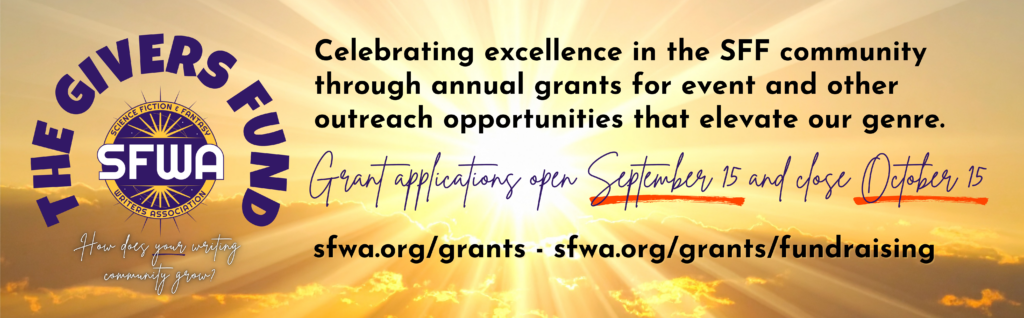
Grant applications open on September 15, 2026 and close on October 15, 2026, which is when the review process begins. Decisions are made by December 1, 2026, and recipients are then notified. We try to pay out everything by the end of the year, but funds may be paid out in January or early February.
15. So let’s say someone applies by October 15 of this year and does not get the funds. Should they re-apply next year?
That depends on the reason it wasn’t funded. If the committee didn’t award anything, chances are good that the same result will happen again, if nothing has changed in your application.
If in doubt, applicants should write to us at givers.grants@sfwa.org.
16. Can recipients of Givers Fund grants re-apply?
Yes. Many do. Previous awards do not guarantee you will receive a grant again, however.
17. What should a grant recipient do if their project falls through? For instance, a global pandemic interrupts their well-laid plans…
They should contact us at givers.grants@sfwa.org. Chances are the funds can be postponed to another year, or may be used for a virtual, instead of in-person, event. If the applicant’s modified plans are within the same structure as the original request, something can likely be worked out.
18. Where does the funding for the Givers Fund grants come from?
The Givers Fund was originally created through a contractual arrangement with HumbleBundle. Almost all Givers Fund dollars were received from HumbleBundle in prior years, when it featured SFWA as a charity about twice a year. Any donor can give specifically to the Givers Fund to help replenish the fund.
19. What are the responsibilities of a grant winner to the program after being awarded the funds?
The IRS requires that SFWA obtain and retain a report from the recipients after the event, explaining how the funds were used. Recipients that fail to provide this report will not be considered for future grants. We especially like it when the report includes pictures, website links, and other media, so we can promote these successful events and projects!
We wish you and your projects the best of luck as you apply for a Givers Fund grant. And don’t forget: Don’t hesitate to ask questions! We want to give your application and project the best chance of success, so reach out with any questions you may have, and spread the word to other eligible applicants.
Any donor can give specifically to the Givers Fund to help replenish the fund.
Applications will be accepted from September 15 to October 15. Please check back at that time for a link.