
by Joyce Reynolds-Ward

Editor’s note: THE INDIE FILES was first launched to provide a space for authors with distinct publishing pathways to talk about their strategies and tools. This conversation is as diverse as the indie SFF universe, and Planetside looks forward to once again elevating a range of voices from SFWA’s Independent Authors Committee. If you’d like to be part of that conversation, please review our archives and reach out to the committee to see what’s already on the roster!
I set up a Patreon recently as part of migrating my catalog from Draft2Digital distribution and discovered that, besides being an established monetization platform, it also helped to organize my writing life!
This wasn’t something I anticipated. I decided to use Patreon in the first place to have a permanent home for short stories without leaving them vulnerable to scraping by AI tools. At the same time, I wanted to work on several projects without burning myself out. Additionally, I thought that using Patreon posts as proof of non-AI-guided human creation for projects in development would be a good idea. And if I made a few dollars a month in the process, well, that’s a steady income.
What I didn’t expect was the sense of relief that washed over me once I took that Patreon live. Even without initial subscribers, I suddenly switched from struggling to work on any of those three projects to doing a little bit of work on each one regularly, without stress.
Using Patreon as an Organizing Tool
One of my most productive periods was when I was regularly serializing several projects on Kindle Vella and Substack. Unfortunately, Vella went away. Substack’s platform is newer and still in development. Plus, Vella and Substack serialization seem to require more intensive posting schedules for visibility, which Patreon doesn’t necessarily.
How does using Patreon as an organizing tool actually work?
- It allows an author to break each project into segments with identifiable deadlines. Instead of jamming them all together on one site or creating separate versions, I could give each project its own section, pricing, and schedule, with greater flexibility than Substack allows.
- Past experience with serialization on Kindle Vella and Substack taught me that trackable deadlines on a spreadsheet are crucial for maintaining multiple projects. The Patreon Library setup provides an easy view of what has been uploaded to create a workable spreadsheet.
- Most crucially, Patreon’s organization and layout allows writers to visualize how to organize these separate sections in a simple manner. My experience managing ADHD remedial structures as a former middle-school special-education teacher has shown me that a tech interface that works well with the individual user is HUGE—and what works differs with each person, whether neurotypical or neurodivergent.
How I Organized Myself Using Patreon
I had four separate sections in mind, which eventually became six payment tiers.
- A monthly release of my previously published short stories for $2, many of which are no longer available elsewhere. I’m also selling individual stories. I didn’t want to bother with the process of listing them as separate stories through distributors, but I wanted them to be available.
- An every-other-week release of chapters from the second novel in a fantasy trilogy, in rough draft form, for $4.
- A neo-Western multiverse time-travel novel that is still in the “where is my story” phase of character development and worldbuilding. I decided to share bits and pieces from that worldbuilding every other week, for $3.
- A memoir about horses in my life that doesn’t require linear drafting, also posted every other week, also for $3.
- Free weekly updates on my writing progress with an optional $1 monetization tier.
- A final tier for $7 gives the reader EVERYTHING.
It sounds like a lot, but the twice-a-month staggered scheduling meant I had space to work on each project without courting burnout, which happened with the Vella/Substack combination. It also provided a simpler interface for people to follow me for specific interests without needing to subscribe to every tier.
I used Patreon’s tier structure to separate the different projects and determine which tier would load in which weeks. I chose Sunday as a universal release date for consistency’s sake and to make it easier on my brain. Then I created headers and determined pricing for each tier.
The Magical Spreadsheet That Keeps It All Together
Spreadsheets. I love using spreadsheets for tracking and organizing purposes. They work well with my cognitive processes.
First, I listed the various postings as columns: weekly updates, short stories, novel, novel-in-development, and horse memoir. Then I set up separate rows for upload dates and live dates. Patreon’s post scheduling method works very well for planning purposes, so I put specific upload and live dates under each posting column, as seen below.

Short stories were listed by month in a separate section with title, upload yes/no, and graphics yes/no (I made a graphic for each story).
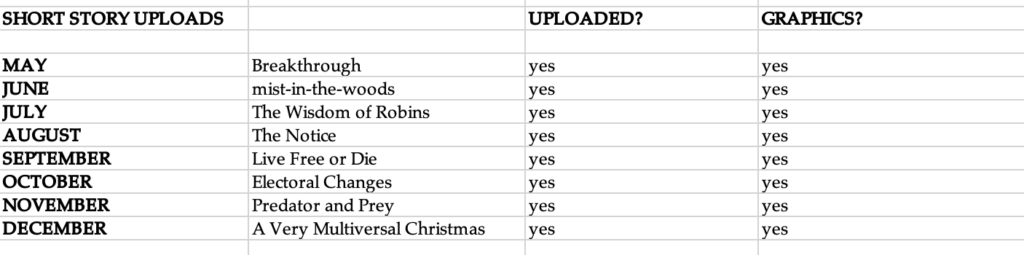
This lets me see where I am at a glance, all in one place. As I work, I can upload the drafts to Patreon, then check what else needs to be prepared for the weeks ahead. Instead of floundering around wondering just where I am on each project, I can look at the spreadsheet, then check my Patreon library to see what I’ve done so far.
Doing a Lot While Staying Sane
Patreon’s organizational tools provide a sense of structure, especially since I have many other things going on that aren’t writing-related. I find it easy to pick up where I left off on a particular project, and I no longer feel pressured to get each project done as fast as possible because otherwise I’ll lose visibility. I’m making progress at a sane pace, I’m documenting my creative process, I’m reissuing my short stories, and…I have breathing room to go through the editing and production process with each book because they are at different stages.
I’d never thought that Patreon would be the tool where all of this comes together, but that appears to be the case for me. It’s well worth checking out to see if it could also work for you.
Explore more articles from THE INDIE FILES
 Joyce Reynolds-Ward has been called “the best writer I’ve never heard of” by one reviewer. She has published over 32 books that include themes of high-stakes family, corporate, and political conflict, digital sapience, personal agency, realistic strong women, and (whenever possible) horses, frequently in Pacific Northwest settings. She is a Self-Published Fantasy Blog-Off semifinalist, a Writers of the Future semifinalist, and an Anthology Builder finalist. She is a member of the Science Fiction and Fantasy Writers Association, co-chair of SFWA’s Independent Author Committee, and a member of Soroptimists International. Her website is at https://www.joycereynolds-ward.com.