
by Rosemary Jones

The first movie tie-in novels date to the rise of silent movies as mass entertainment at the beginning of the 20th century. As with movie tie-in books today, these included both novelizations of screenplays and reissues of published novels illustrated with movie stills.
Newspapers Inspire Early Movie Tie-Ins
The novelization of The Adventures of Kathlyn is one of the earliest movie tie-in novels. This serial began on December 29, 1913, and was shown in movie theaters through 1914. One of the action heroines of silent movies, the film’s star, Kathlyn Williams, was famous for performing with big cats. The movie took advantage of her talents and first name. Over the course of 13 episodes, the fictional Kathlyn rescues her explorer father and frees the enslaved population of a mythical kingdom. She traverses jungles, battles wild beasts, outwits the insidious Council of Three, and dodges a forced marriage to a foul prince. Each episode ended with a cliffhanger guaranteed to bring the audience back to enjoy the next installment until the story’s happy resolution.
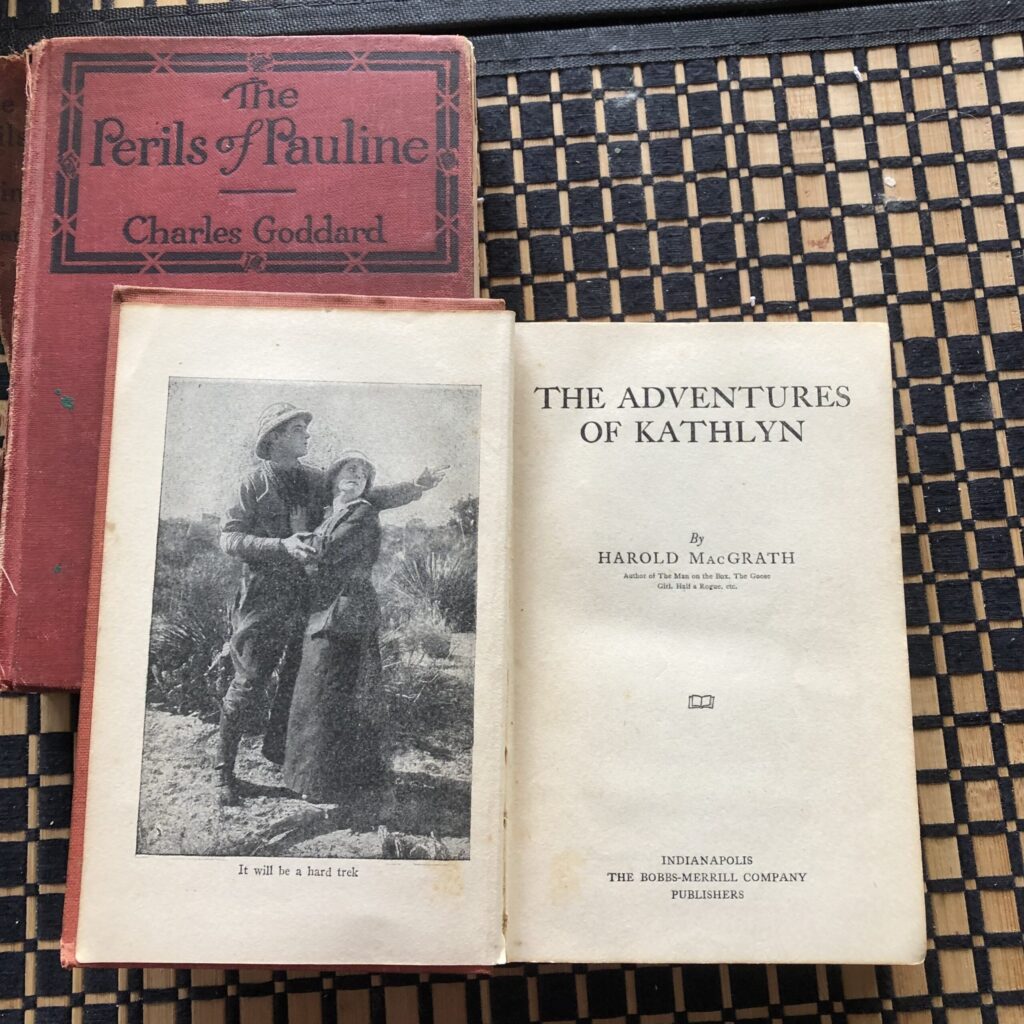
Harold McGrath, who supplied the original story for the screenplay, wrote the novel published by The Bobbs-Merrill Company. The text was illustrated with black-and-white photos from the film. The frontispiece opposite the title page shows Kathlyn clutching the hunter Bruce, who aids her quest to rescue her father and provides a romantic interest.
Newspapers such as the Chicago Tribune and Los Angeles Times also featured stories illustrated with stills from The Adventures of Kathlyn. This was designed to boost sales of the newspapers, the serial, and the book, cashing in on every possible way to keep the public intrigued by Kathlyn’s trials and tribulations. It was all coordinated, with the Chicago Tribune helping to finance the movie production in hopes of boosting their circulation. The Motion Picture News noted film screenings ended with a reminder to read about Kathlyn in the Sunday newspaper, while the newspaper stories urged fans to go to the “picture theater” to watch the next episode.
Photoplays Become Bestsellers
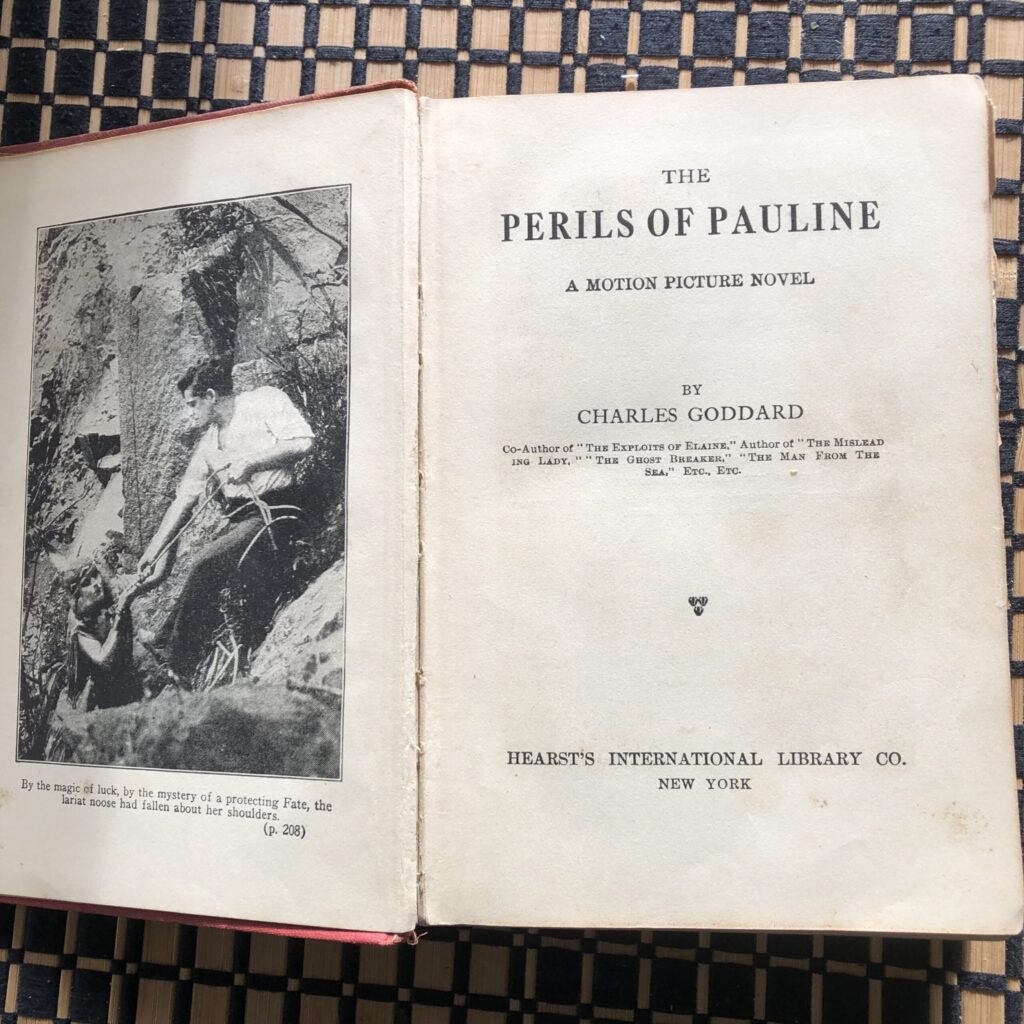
The Adventures of Kathlyn launched the popular format of action serials with cliffhanger endings, most famously The Perils of Pauline (1914). Funded by newspaper magnate William Randolph Hearst and written by playwright Charles Goddard, the serial put star Pearl White in dangerous situations, including being menaced by a gorilla (a costumed actor as opposed to the real big cats used in The Adventures of Kathlyn). Fifteen black-and-white photos of Pauline’s adventures accompanied Goddard’s novelization, which Hearst’s International Library Co. published. The title page proclaims it is “a motion picture novel.”
These early novels convinced other publishers that movies made great books. Novelizations of movies and books illustrated with film stills were quickly released. Hundreds of titles were in print by the 1920s.
In the United States, New York publishers A.L. Burt and Grosset & Dunlap were the most prolific publishers of movie tie-in novels. Both publishers specialized in issuing cheap hardcover reprints of popular fiction and classics. As silent movies adapted these stories to film, publishers found it easy to insert four to eight stills into their versions. Colorful dust jackets trumpeted that the book was the basis for the movie and named popular film stars as prominently as authors. Both publishers used the term photoplays to describe these books illustrated with movie stills. Grosset’s advertisements trumpeted that their books allowed the audience “the secret of enjoying the films over and over again in a comfortable armchair by your own fireside.”
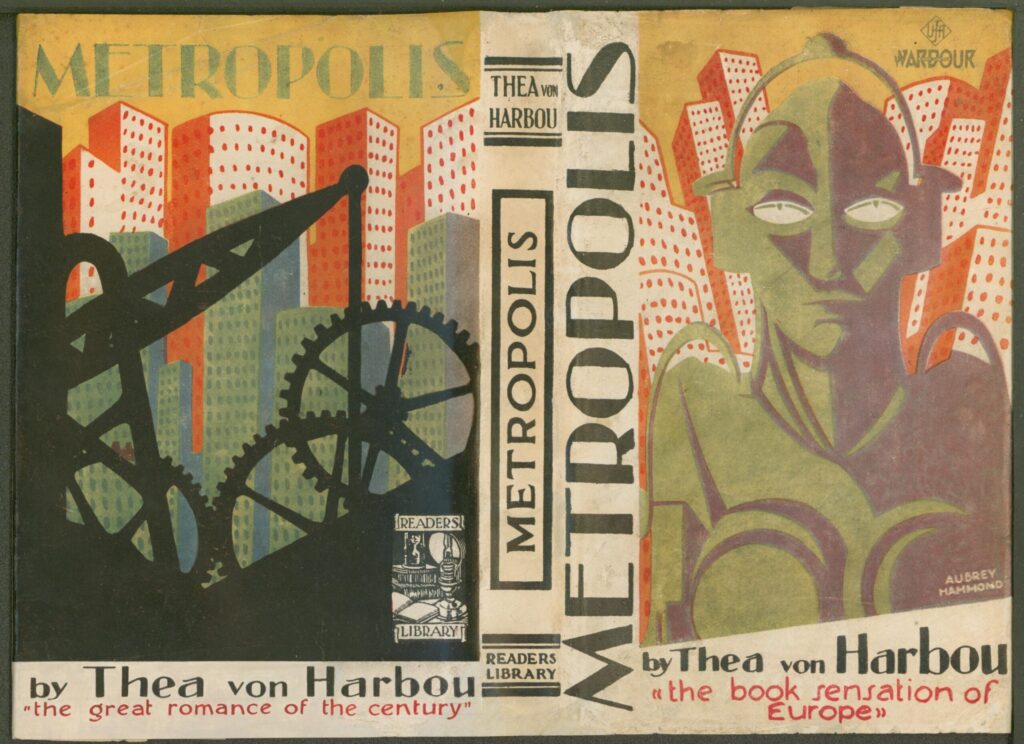
Silent movies were a worldwide phenomenon, as were movie tie-in books. German scriptwriter Thea Von Harbou’s novel Metropolis appeared in multiple languages with illustrations from the 1927 silent movie directed by Fritz Lang. The Readers Library (UK) dust jacket art emphasizes the movie’s Art Deco design and robot. Von Harbou also wrote The Rocket to the Moon, which was the basis for Lang’s 1929 silent movie Frau in Mond (Woman in the Moon). The illustrated movie tie-in edition released by Readers Library used the title The Girl in the Moon.
More Science Fiction, Fantasy, and Horror Tie-Ins
Today, silent movie tie-in novels featuring science fiction, fantasy, and horror films attract the most interest from collectors. Some of these are still famous films, like Metropolis. Others are more obscure, like the 1916 version of Jules Verne’s 20,000 Leagues Under the Sea. Some films are lost, such as the 1922 edition of The Young Diana, inspired by Marie Corelli’s earlier novel. The movie tie-in version is the only way to see how Marion Davies portrayed its heroine, who is rejuvenated by a scientist. But all are testimony to the importance of science fiction and fantasy in the silent era.
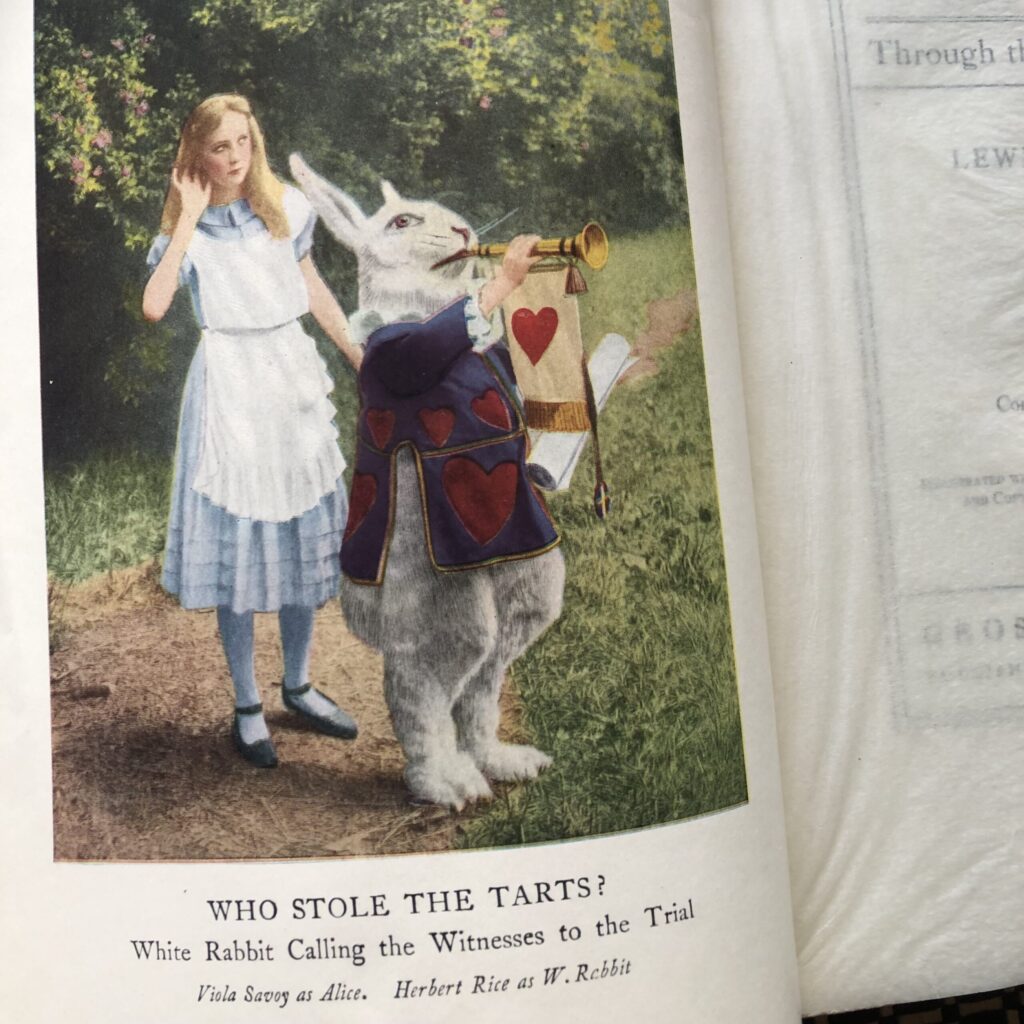
A childhood favorite adapted to film early on was Alice’s Adventures in Wonderland. Grosset published an oversized gift edition with photos from the 1915 silent movie. An account of how the picture was filmed before a live audience at the Savoy Theatre appears at the beginning of the book.
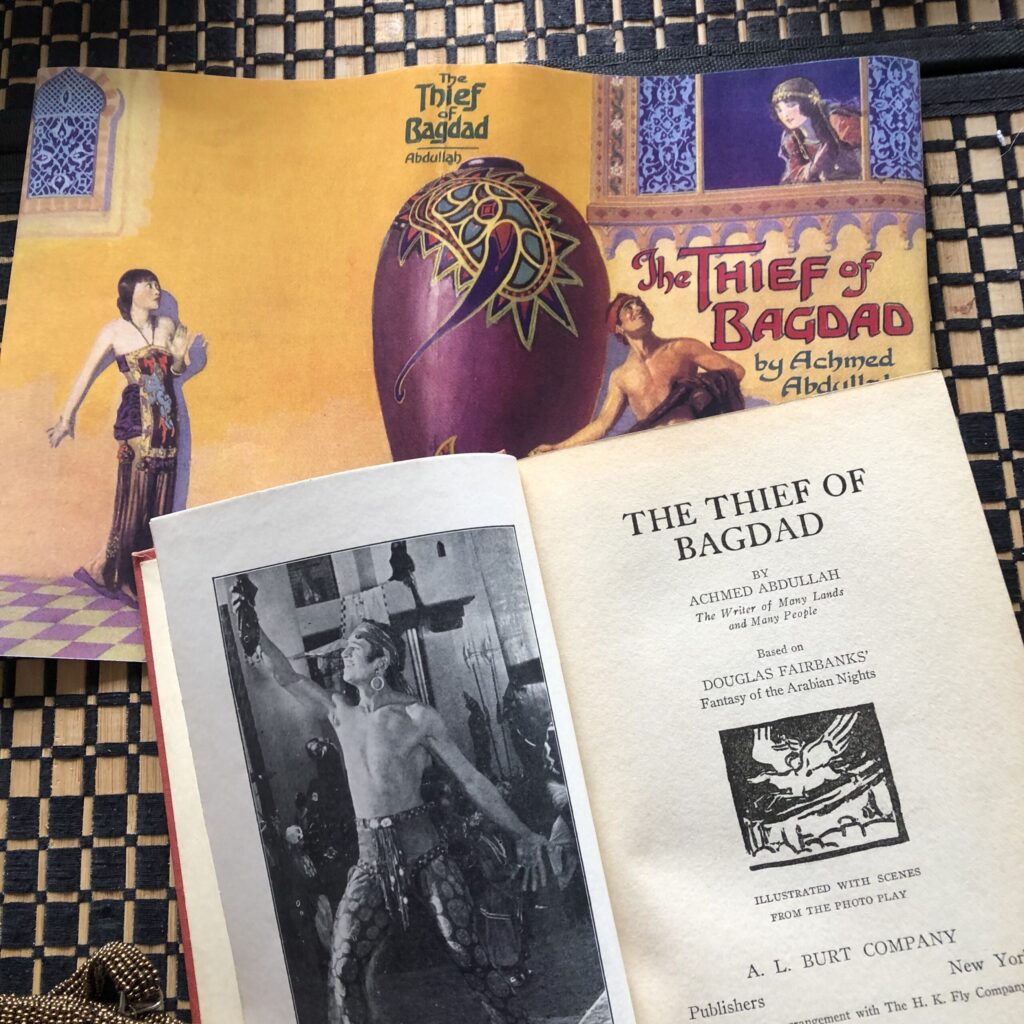
Douglas Fairbanks’s Thief of Baghdad (1924) was a stunt and special-effects fantasy extravaganza. The novelization was done by Achmed Abudallah, who listed himself as “the writer of many lands and many people.” As was common in the silent era, Abudallah’s biography sounded as romantic as his stories, claiming he was the son of a Persian princess and an exiled noble cousin of the last Russian czar. The A. L. Burt edition featured a wraparound dust jacket art by Willy Pogany with Fairbanks and his princess on the front and the Chinese American actress Anna May Wong in her breakout role as a villainess on the back.
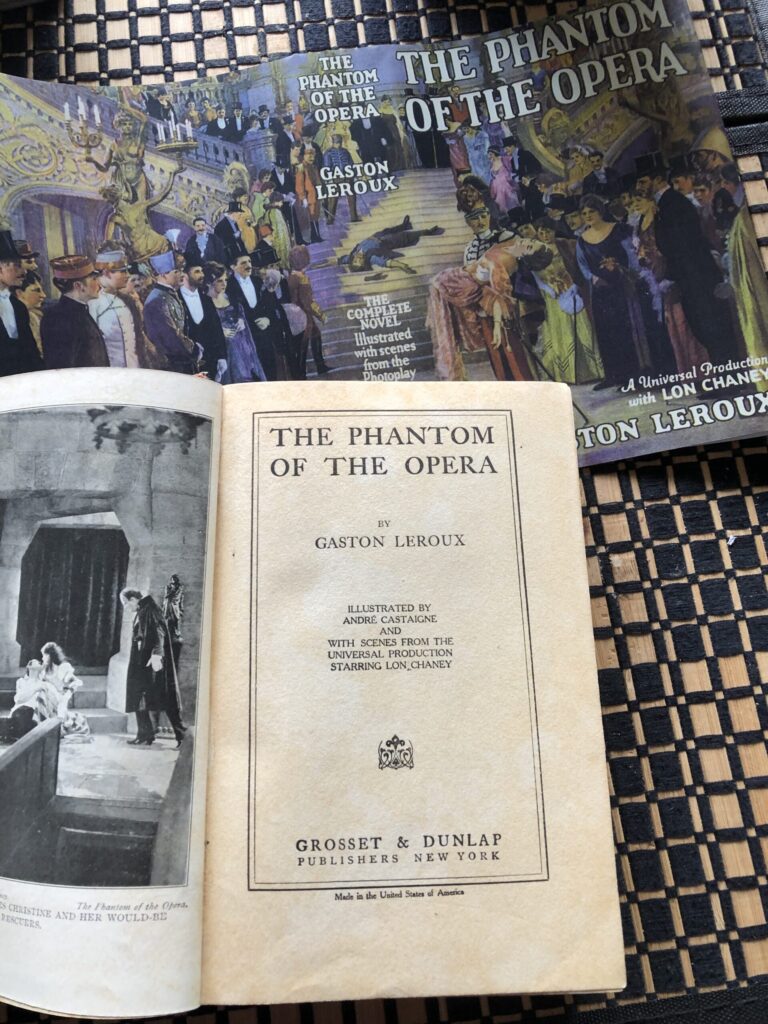
Lon Chaney’s groundbreaking, fantastic make-up in horror films is evident in the movie tie-in version of The Phantom of the Opera (1925). The book features four stills from the movie, two double-page color plates from earlier editions of the novel, and a wraparound dust jacket where the dead body on the grand staircase is cleverly centered on the spine. So, whether face-out or spine-only, this book was sure to attract fans of the Phantom.
Enduring Connection to Silent Films
While the Jazz Singer and other sound experiments ended the silent movie era by 1930, the movie tie-in novel remained strong. Every decade has brought new movie tie-in novels, novelizations, and spin-offs in ever-increasing numbers.
But these silent movie tie-in books make charming reminders of early science fiction, fantasy, and horror films. Sometimes they are the easiest versions to find. Only fragments of The Adventures of Kathlyn remain in existence (which can be watched on YouTube courtesy of the Eye Filmmuseum), but McGrath’s novel is widely available in the used-book market.
Explore more articles from THE HISTORY FILES
 Rosemary Jones collects illustrated fiction, including Photoplays. She has authored seven novels based on games, including two for Forgotten Realms/Wizards of the Coast and five for Arkham Horror/Aconyte. Her latest AH novels, The Nightmare Quest of April May and The Arcane Gamble of Harvey Walters, feature books from her collection tucked on the characters’ bookshelves. More about her writing can be found at rosemaryjones.com. Pictures of her book collection are available at @lost_loves_books on Instagram.