
by Randall Hayes, PhD

In these early days of artificial intelligence, when hallucinated facts and completely fabricated reference sources are disturbingly common, there is substantial value for fiction writers in being able to navigate structured databases of primary and secondary scientific research, usually in the form of articles in academic journals. For the uninitiated, primary articles are written by the people who performed the experiments and peer-reviewed by other objective scientists. Secondary review articles are written by scholars, who may or may not be experimentalists themselves, who compare, integrate, and evaluate results from multiple primary articles. Tertiary sources are journalistic articles written by non-specialists, such as this one.
Some academic disciplines maintain their own idiosyncratic databases, such as ArXiv, but we’ll focus on the National Library of Medicine’s PubMed, which now requires that any new article based on research funded by the federal government be uploaded to its servers as a free and publicly accessible full-text version, or at least linked to an equally available free version at the publisher’s website. This policy applies only to recent work; older articles may be immediately available only in abstract form. An abstract is a summary meant to give the reader some insight as to whether it’s worth the effort to track down the full paper.
Where to Start
For authors who may be specialists in their own fields but not others, or who may be self-taught generalists, starting higher up in the stack is advisable. Journalists will provide some interpretation and context based on their own previous research, and some will provide links to reference papers for further research. Even when they don’t, they will name their sources, and those names can be plugged into PubMed as an author search. For instance, either “Randall Hayes” or “Hayes Randall” will pull up a single Cerebral Cortex paper from 2006, based on my dissertation research with stroke patients. This is a primary journal article. It includes an introduction section intended to provide some context before presenting the results of my specific experiments, and a discussion that tries to interpret those new results. However, those sections are largely lists of references to other papers. Most career scientists read these things in light of their long experience, and much remains unsaid.
For getting up to speed on what professionals think of a field or even a specific research question within a field—what the controversies are, where there are holes ripe to be speculated on in a story—the secondary reviews are the place for SF authors to focus. Reviews will provide more context, more cognitive scaffolding in the form of commentary and conceptual diagrams. Often, these will take the form of flow charts or causal models, which are wonderful for sparking thought experiments. Such as:
- What if this arrow were missing/broken, and what could plausibly break it in my story?
- What if we could bypass this other element? How might we do that?
Sometimes these static diagrams can be animated for further insight, using simple tools like Nicky Case’s LOOPY.
How to Find a Review
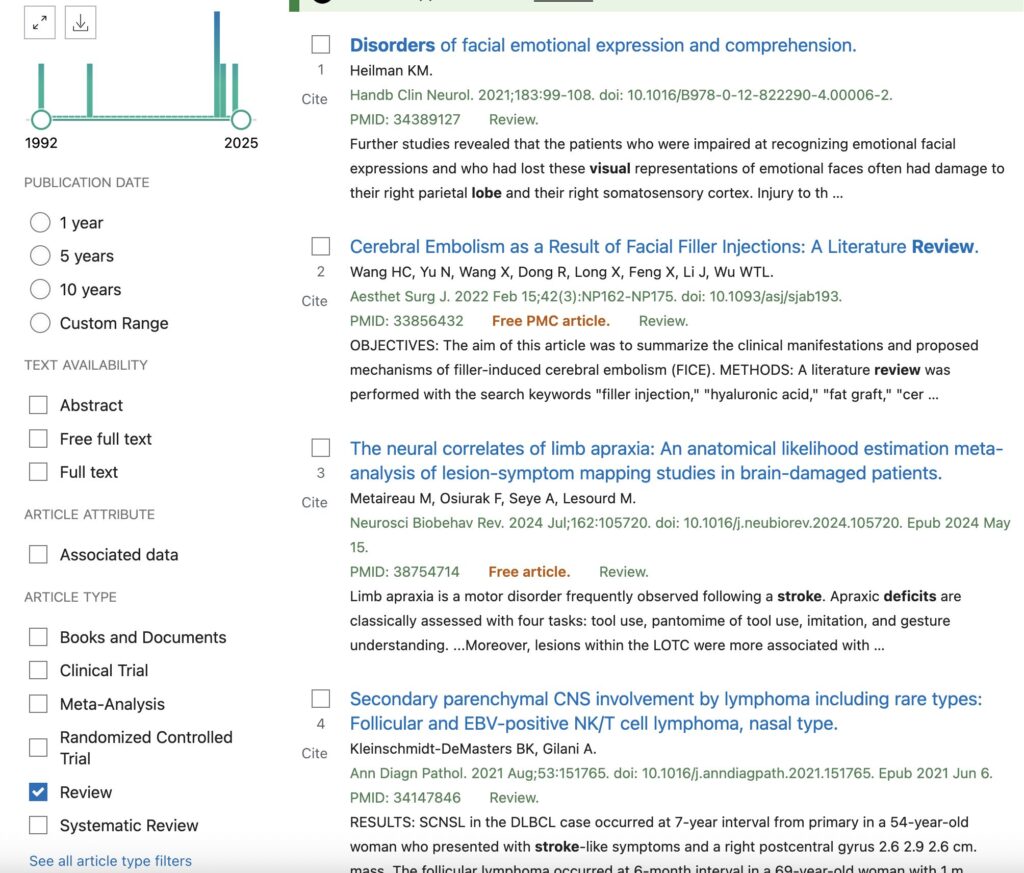
The easiest way is simply to ask for one by typing in a search query. For instance, a query inspired by my paper above could be “visual deficits in temporal lobe stroke review.” The current version of PubMed will break down the search terms and map them to its standard controlled vocabulary of MeSH. This step is typically hidden unless you click the plus icon to the right of the “View Search Details” banner beneath the search bar. This query yields 13 results, which is manageable, but limiting it to reviews is as simple as clicking the “Reviews” box in the filter sidebar on the left-hand side of the page.
Evaluating the Search Results
The first article, “Disorders of facial expression and comprehension,” from 2021, could drive a narrative. It turns out that this particular paper is actually a chapter in a book called Handbook of Clinical Neurology. There is an abstract but no full-text on PubMed. The publisher adds some snippets and the references, but not the full paper. This might seem like a dead end, but depending on your purpose, it may not be. For example, if all you want is the general idea that people with right-hemisphere lesions have difficulty reading faces but not experiencing emotions themselves, that might be enough to generate a story on its own.
But let’s say you were struck by the phrase, “The participants with right- or left-hemispheric strokes attempted to determine if two different actors were displaying the same or different emotions,” from the abstract. That specific test could be the basis for a scene in your story. How was the experiment done? This is somewhat more difficult, as most of the references at the publisher’s website are older. Plugging them back into another PubMed search does not reveal full-text versions, whose “Methods” sections would describe in some detail the data-collection protocol. The author, Kenneth Heilman, would have had a personal lab webpage at the University of Florida, where he might have maintained web-accessible copies of his own papers, but Dr. Heilman died in 2024. Putting his name into Google Scholar reveals 50 of his papers publicly accessible, but not that one. This situation will likely require the assistance of a librarian. Best to move on for now.
The second search result, however, “Cerebral Embolism as a Result of Facial Filler Injections,” from the Aesthetic Surgery Journal in 2022, has a full-text version in PubMed, with a list of individual cases and pictures! Perhaps the testing scene could be replaced with a surgery scene detailing what caused the stroke in the first place. Then the discovery narrative might be less about the detailed neurological consequences of the embolism and more about how to hold the surgeon accountable.
Combining thoughts from multiple papers into a sort of Venn diagram of narrative possibilities is the essence of how I work with scientific literature. I only drill down for details when I need them to enhance the reader’s experience. I also encourage serendipity, as in the workflow above.
Explore more articles from Writing from Science
Randall Hayes, “your friendly neighborhood neuroscientist,” has been publishing science fact articles online for about 10 years, starting at the Intergalactic Medicine Show and, since its closure, branching out to other venues such as Utopia Science Fiction and Trollbreath Magazine. A currently incomplete list of his work is at the Internet Speculative Fiction Database. His personal newsletter, Doctor Eclectic, is at randallhayes.substack.com.