
by J.D. Henning

Look at your keyboard. If you’re on a phone, pull it up for a sec. You’re probably looking at a QWERTY layout. Even with the unlimited theoretical possibilities of a touchscreen, this is what the vast majority of English users see.
But it’s crap. And we’ve known it’s crap for more than a century.
This all became painfully personal to me in the winter of 2021 when my hands went on strike. As a film editor and screenwriter, my life revolves around my computer. Samurai had their swords, and I have my keyboard. But my hands burned like fire, and my most trusted tool turned out to be the culprit. Repetitive stress injuries are no fun at all. And the horrible part is that a QWERTY keyboard is essentially made to encourage RSIs.
How We Got Here
At their advent in the 1870s, keyboards were ingeniously designed boxes of buttons and levers with actual physical bits of metal slamming against actual physical paper, imprinting ink every time a writer (for the sake of this example, you) hit a key. Problem was, if you really got on a roll—your Dracula/Moby-Dick mashup started to get really juicy—you might jam the typewriter. One lever would interrupt another, and Dracula could not look deeply into the White Whale’s eyes until your machine was serviced.
Unacceptable.
The industrious designers at Remington & Sons—yes, the rootin’ tootin’ gunmakers—rearranged the keyboard to lessen the likelihood of a jam. This also slowed down your typing speed. So, they intentionally put letters in spots bad for you and good for the machine, because slowly sucking the blood of a whale is better than not sucking it at all. Mr. Remington’s keyboard layout quickly became the standard. And, because we, as humans, don’t like to learn new things, the QWERTY layout stayed in use even when all the mechanical reasons for the QWERTY format disappeared. Hence, your iPhone defaults to it even now, despite making no ergonomic sense at all. We have, by the way, known of its fatiguing nature since the 1910s.
I needed something else for my writing. Something that was made to give priority to the human doing the typing rather than the factory making the tool. Something that wouldn’t make my hands feel like burning charcoal briquettes. Enter stenography.
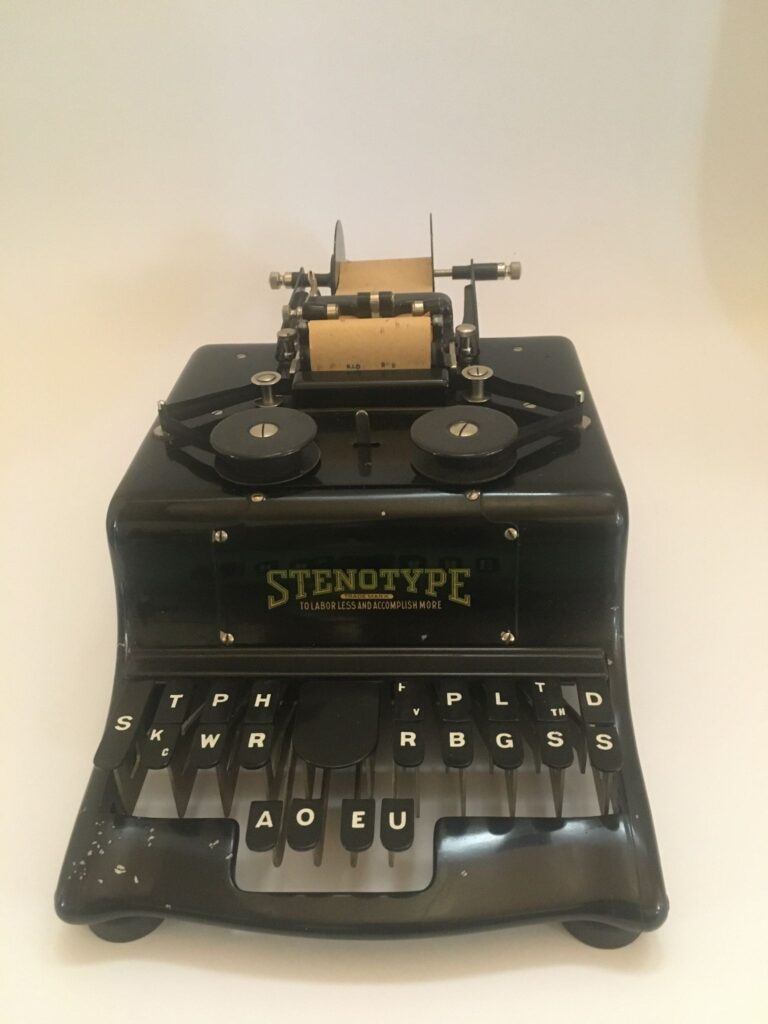
Stenotype Fights Back
The stenotype machine came about not long after the typewriter, and was, itself, an evolution of shorthand. Heard of Charles Dickens, Agatha Christie, or George Bernard Shaw? They all used shorthand. The invention of a machine further standardized the shorthand system, and the advent of electronic stenotype simplified the process even further. Hobbyists have since come along and created free programs to allow anyone to stenotype on their computers.
So, why doesn’t everyone use it?
Remember how I threw shade at the whole human race for not wanting to learn new things? Several paragraphs later, that’s still true. And it goes in spades for stenography.
How Stenography Works
Stenotype is fundamentally different from a typical keyboard. At its root, it’s phonetic. The 23 keys roughly correspond to the sounds in our English language. A word like ‘though’ only needs the phonetic sounds TH and the long O sound. Thus, “though” becomes “THOE.” Add in that these letters are all pressed at the same time and are ergonomically clustered together, and suddenly, my hands have stopped talking about unionizing.
Of course, the complexity of stenotype rises quickly, as there are plenty of homophones and other weird quirks of the English language. This is where another critical element of machine stenography comes in. It’s basically an enormous list of shortcuts, called outlines. The phonetic base exists for many words, but for all the many, many exceptions to these rules, you have outlines.
Outlines work for phrases as well as words. If, for example, there is a phrase that comes up all the time in your current project, such as “Alucrad gazed at the white whale, trembling with delight,” you could add an outline for the whole thing. Maybe A*GD. If your hands are as finicky as mine, the ergonomic benefits pile up quite quickly: You’re hitting four rather than 56 keys, and the ones you are pressing don’t require your hands to contort to press them. It’s also much faster, both for this phrase and as a whole.
How fast? It varies based on experience, but to qualify as a stenotype court reporter, you need to get to 225 words per minute. And just think: Court reporters do this all day, every day. If ever there was a job serious about ergonomics, it would be this one.
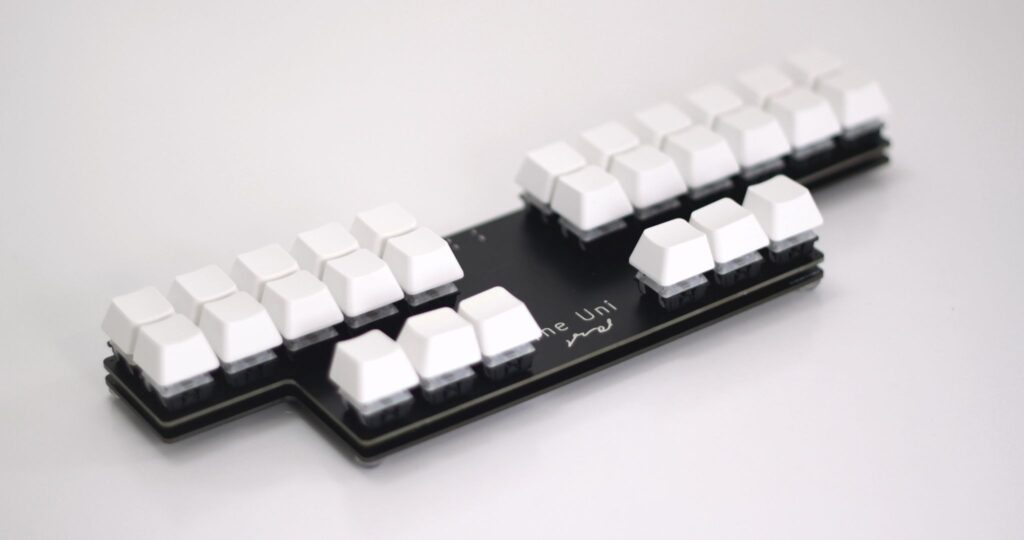
Is Stenography for You?
The process of learning steno is probably closest to learning to play a musical instrument. This is another way of saying that it is difficult, though how difficult will depend on the person. Is it worth it for the average writer? Probably not, especially if a good old QWERTY keyboard is working fine for you. Learning to stenotype would be like deciding to learn the guitar if you want to master music composition. Will it be helpful? Probably. Is it strictly necessary? No.
It can, though, be a lifesaver for someone with RSI or other hand mobility issues.
The basics of learning stenography are the same as most skills: practice, persistence, and patience. I followed a free guide (available here) and worked my way through it over two years. That’s a long time, but my wife and I also had two children during that time. Unless you plan on popping out progeny at the same rate, your timeframe will likely differ from mine.
I can now steno quickly enough for day-to-day work (I’m stenotyping right now). For my next big writing project, I plan to mostly stenotype. I’m still slower at this than QWERTY, but I want to write for a lifetime. And an ergonomic, sustainable writing method is, like that great white whale, a goal certainly worth pursuing.
Editor’s note: To learn more about stenography, see How Steno Works At 200 WPM.
Explore more articles from Writing by Other Means
 J.D. Henning is a writer and filmmaker. Best known for writing and executive producing Portal Runner, a New York Times recommended sci-fi film, J.D. also recently took home the prize at the 2025 Worldcon film festival for his short film Superior Subject. J.D. can’t escape an incessant need to write in genre, whether it be spies, spaceships, or zombies. He’s the father of two young children. He, his wife, kids, and cat can be found cross-country skiing in his home state of Montana (well…maybe not the cat). You can learn more about his work at henningworks.com.